In databases, a synonym is an alias or alternate name for a table, view, sequence, or other schema object. They are used mainly to make it intuitive for users to access database objects owned by other users. They also hide the underlying object's identity and make it harder for a malicious program or user to target the underlying object (security through obscurity). Because a synonym is just an alternate name for an object, it requires no storage other than its definition. When an application uses a synonym, the DBMS forwards the request to the synonym's underlying base object. By coding your programs to use synonyms instead of database object names, you insulate yourself from any changes in the name, ownership, or object locations, at the cost of adding another layer that also needs to be maintained. Users can also have different needs, for example some may wish to use a shorter name to refer to database objects they often query, which can be done with aliases without having to rename the underlying object and alter the code referring to it. Synonyms are very powerful from the point of view of allowing users access to objects that do not lie within their schema. All synonyms have to be created explicitly with the CREATE SYNONYM command and the underlying objects can be located in the same database or in other databases that are connected by database links There are two major uses of synonyms: Object invisibility: Synonyms can be created to keep the original object hidden from the user. Location invisibility: Synonyms can be created as aliases for tables and other objects that are not part of the local database. When a table or a procedure is created, it is created in a particular schema, and other users can access it only by using that schema's name as a prefix to the object's name. The way around for this is for the schema owner creates a synonym with the same name as the table name. == Public synonyms == Public synonyms are owned by special schema in the Oracle Database called PUBLIC. As mentioned earlier, public synonyms can be referenced by all users in the database. Public synonyms are usually created by the application owner for the tables and other objects such as procedures and packages so the users of the application can see the objects The following code shows how to create a public synonym for the employee table: Now any user can see the table by just typing the original table name. If you wish, you could provide a different table name for that table in the CREATE SYNONYM statement. Remember that the DBA must create public synonyms. Just because you can see a table through public (or private) synonym doesn’t mean that you can also perform SELECT, INSERT, UPDATE or DELETE operations on the table. To be able to perform those operations, a user needs specific privileges for the underlying object, either directly or through roles from the application owner. == Private synonyms == A private synonym is a synonym within a database schema that a developer typically uses to mask the true name of a table, view stored procedure, or other database object in an application schema. Private synonyms, unlike public synonyms, can be referenced only by the schema that owns the table or object. You may want to create private synonyms when you want to refer to the same table by different contexts. Private synonym overrides public synonym definitions. You create private synonyms the same way you create public synonyms, but you omit the PUBLIC keyword in the CREATE statement. The following example shows how to create a private synonym called addresses for the locations table. Note that once you create the private synonym, you can refer to the synonym exactly as you would the original table name. == Drop a synonym == Synonyms, both private and public, are dropped in the same manner by using the DROP SYNONYM command, but there is one important difference. If you are dropping a public synonym; you need to add the keyword PUBLIC after the keyword DROP. The ALL_SYNONYMS (or DBA_SYNONYMS) view provides information on all synonyms in your database.
Medical imaging
Medical imaging is the technique and process of imaging the interior of a body for clinical analysis and medical intervention, as well as visual representation of the function of some organs or tissues (physiology). Medical imaging seeks to reveal internal structures hidden by the skin and bones, as well as to diagnose and treat disease. Medical imaging also establishes a database of normal anatomy and physiology to make it possible to identify abnormalities. Although imaging of removed organs and tissues can be performed for medical reasons, such procedures are usually considered part of pathology instead of medical imaging. Measurement and recording techniques that are not primarily designed to produce images, such as electroencephalography (EEG), magnetoencephalography (MEG), electrocardiography (ECG), and others, represent other technologies that produce data susceptible to representation as a parameter graph versus time or maps that contain data about the measurement locations. In a limited comparison, these technologies can be considered forms of medical imaging in another discipline of medical instrumentation. As of 2010, 5 billion medical imaging studies had been conducted worldwide. Radiation exposure from medical imaging in 2006 made up about 50% of total ionizing radiation exposure in the United States. Medical imaging equipment is manufactured using technology from the semiconductor industry, including CMOS integrated circuit chips, power semiconductor devices, sensors such as image sensors (particularly CMOS sensors) and biosensors, and processors such as microcontrollers, microprocessors, digital signal processors, media processors and system-on-chip devices. As of 2015, annual shipments of medical imaging chips amount to 46 million units and $1.1 billion. The term "noninvasive" is used to denote a procedure where no instrument is introduced into a patient's body, which is the case for most imaging techniques used. == History == In 1972, engineer Godfrey Hounsfield from the British company EMI invented the X-ray computed tomography device for head diagnosis, which is commonly referred to as computed tomography (CT). The CT nucleus method is based on the projecting X-rays through a section of the human head, which are then processed by computer to reconstruct the cross-sectional image, known as image reconstruction. In 1975, EMI successfully developed a CT device for the entire body, enabling the clear acquisition of tomographic images of various parts of the human body. This revolutionary diagnostic technique earned Hounsfield and physicist Allan Cormack the Nobel Prize in Physiology or Medicine in 1979. Digital image processing technology for medical applications was inducted into the Space Foundation's Space Technology Hall of Fame in 1994. By 2010, over 5 billion medical imaging studies had been conducted worldwide. Radiation exposure from medical imaging in 2006 accounted for about 50% of total ionizing radiation exposure in the United States. Medical imaging equipment is manufactured using technology from the semiconductor industry, including CMOS integrated circuit chips, power semiconductor devices, sensors such as image sensors (particularly CMOS sensors) and biosensors, as well as processors like microcontrollers, microprocessors, digital signal processors, media processors and system-on-chip devices. As of 2015, annual shipments of medical imaging chips reached 46 million units, generating a market value of $1.1 billion. == Types == In the clinical context, "invisible light" medical imaging is generally equated to radiology or "clinical imaging". "Visible light" medical imaging involves digital video or still pictures that can be seen without special equipment. Dermatology and wound care are two modalities that use visible light imagery. Interpretation of medical images is generally undertaken by a physician specialising in radiology known as a radiologist; however, this may be undertaken by any healthcare professional who is trained and certified in radiological clinical evaluation. Increasingly interpretation is being undertaken by non-physicians, for example radiographers frequently train in interpretation as part of expanded practice. Diagnostic radiography designates the technical aspects of medical imaging and in particular the acquisition of medical images. The radiographer (also known as a radiologic technologist) is usually responsible for acquiring medical images of diagnostic quality; although other professionals may train in this area, notably some radiological interventions performed by radiologists are done so without a radiographer. As a field of scientific investigation, medical imaging constitutes a sub-discipline of biomedical engineering, medical physics or medicine depending on the context: Research and development in the area of instrumentation, image acquisition (e.g., radiography), modeling and quantification are usually the preserve of biomedical engineering, medical physics, and computer science; Research into the application and interpretation of medical images is usually the preserve of radiology and the medical sub-discipline relevant to medical condition or area of medical science (neuroscience, cardiology, psychiatry, psychology, etc.) under investigation. Many of the techniques developed for medical imaging also have scientific and industrial applications. === Radiography === Two forms of radiographic images are in use in medical imaging. Projection radiography and fluoroscopy, with the latter being useful for catheter guidance. These 2D techniques are still in wide use despite the advance of 3D tomography due to the low cost, high resolution, and depending on the application, lower radiation dosages with 2D technique. This imaging modality uses a wide beam of X-rays for image acquisition and is the first imaging technique available in modern medicine. Fluoroscopy produces real-time images of internal structures of the body in a similar fashion to radiography, but employs a constant input of X-rays, at a lower dose rate. Contrast media, such as barium, iodine, and air are used to visualize internal organs as they work. Fluoroscopy is also used in image-guided procedures when constant feedback during a procedure is required. An image receptor is required to convert the radiation into an image after it has passed through the area of interest. Early on, this was a fluorescing screen, which gave way to an Image Amplifier (IA) which was a large vacuum tube that had the receiving end coated with cesium iodide, and a mirror at the opposite end. Eventually the mirror was replaced with a TV camera. Projectional radiographs, more commonly known as X-rays, are often used to determine the type and extent of a fracture as well as for detecting pathological changes in the lungs. With the use of radio-opaque contrast media, such as barium, they can also be used to visualize the structure of the stomach and intestines – this can help diagnose ulcers or certain types of colon cancer. === Magnetic resonance imaging === A magnetic resonance imaging instrument (MRI scanner), or "nuclear magnetic resonance (NMR) imaging" scanner as it was originally known, uses powerful magnets to polarize and excite hydrogen nuclei (i.e., single protons) of water molecules in human tissue, producing a detectable signal that is spatially encoded, resulting in images of the body. The MRI machine emits a radio frequency (RF) pulse at the resonant frequency of the hydrogen atoms on water molecules. Radio frequency antennas ("RF coils") send the pulse to the area of the body to be examined. The RF pulse is absorbed by protons, causing their direction with respect to the primary magnetic field to change. When the RF pulse is turned off, the protons "relax" back to alignment with the primary magnet and emit radio waves in the process. This radio-frequency emission from the hydrogen atoms on water is what is detected and reconstructed into an image. The resonant frequency of a spinning magnetic dipole (of which protons are one example) is called the Larmor frequency and is determined by the strength of the main magnetic field and the chemical environment of the nuclei of interest. MRI uses three electromagnetic fields: a very strong (typically 1.5 to 3 teslas) static magnetic field to polarize the hydrogen nuclei, called the primary field; gradient fields that can be modified to vary in space and time (on the order of 1 kHz) for spatial encoding, often simply called gradients; and a spatially homogeneous radio-frequency (RF) field for manipulation of the hydrogen nuclei to produce measurable signals, collected through an RF antenna. Like CT, MRI traditionally creates a two-dimensional image of a thin "slice" of the body and is therefore considered a tomographic imaging technique. Modern MRI instruments are capable of producing images in the form of 3D blocks, which may be considered a generalization of the single-slice
Outline of robotics
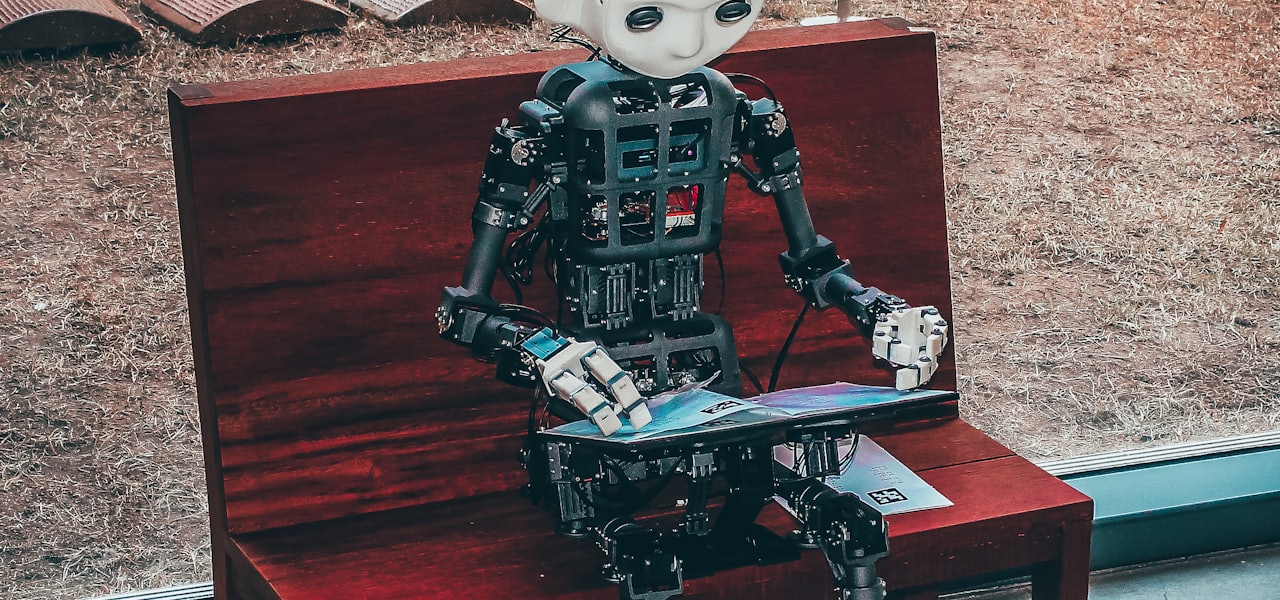
The following outline is provided as an overview of and topical guide to robotics: Robotics is a branch of mechanical engineering, electrical engineering and computer science that deals with the design, construction, operation, and application of robots, as well as computer systems for their control, sensory feedback, and information processing. These technologies deal with automated machines that can take the place of humans in dangerous environments or manufacturing processes, or resemble humans in appearance, behaviour, and or cognition. Many of today's robots are inspired by nature contributing to the field of bio-inspired robotics. The word "robot" was introduced to the public by Czech writer Karel Čapek in his play R.U.R. (Rossum's Universal Robots), published in 1920. The term "robotics" was coined by Isaac Asimov in his 1941 science fiction short-story "Liar!" == Nature of robotics == Robotics can be described as: An applied science – scientific knowledge transferred into a physical environment. A branch of computer science – A branch of electrical engineering – A branch of mechanical engineering – Research and development – A branch of technology – == Branches of robotics == Adaptive control – control method used by a controller which must adapt to a controlled system with parameters which vary, or are initially uncertain. For example, as an aircraft flies, its mass will slowly decrease as a result of fuel consumption; a control law is needed that adapts itself to such changing conditions. Aerial robotics – development of unmanned aerial vehicles (UAVs), commonly known as drones, aircraft without a human pilot aboard. Their flight is controlled either autonomously by onboard computers or by the remote control of a pilot on the ground or in another vehicle. Android science – interdisciplinary framework for studying human interaction and cognition based on the premise that a very humanlike robot (that is, an android) can elicit human-directed social responses in human beings. Anthrobotics – science of developing and studying robots that are either entirely or in some way human-like. Artificial intelligence – the intelligence of machines and the branch of computer science that aims to create it. Artificial neural networks – a mathematical model inspired by biological neural networks. Autonomous car – an autonomous vehicle capable of fulfilling the human transportation capabilities of a traditional car Autonomous research robotics – Bayesian network – BEAM robotics – a style of robotics that primarily uses simple analogue circuits instead of a microprocessor in order to produce an unusually simple design (in comparison to traditional mobile robots) that trades flexibility for robustness and efficiency in performing the task for which it was designed. Behavior-based robotics – the branch of robotics that incorporates modular or behavior based AI (BBAI). Bio-inspired robotics – making robots that are inspired by biological systems. Biomimicry and bio-inspired design are sometimes confused. Biomimicry is copying the nature while bio-inspired design is learning from nature and making a mechanism that is simpler and more effective than the system observed in nature. Biomimetic – see Bionics. Biomorphic robotics – a sub-discipline of robotics focused upon emulating the mechanics, sensor systems, computing structures and methodologies used by animals. Bionics – also known as biomimetics, biognosis, biomimicry, or bionical creativity engineering is the application of biological methods and systems found in nature to the study and design of engineering systems and modern technology. Biorobotics – a study of how to make robots that emulate or simulate living biological organisms mechanically or even chemically. Cloud robotics – is a field of robotics that attempts to invoke cloud technologies such as cloud computing, cloud storage, and other Internet technologies centered around the benefits of converged infrastructure and shared services for robotics. Cognitive robotics – views animal cognition as a starting point for the development of robotic information processing, as opposed to more traditional Artificial Intelligence techniques. Clustering – Computational neuroscience – study of brain function in terms of the information processing properties of the structures that make up the nervous system. Robot control – a study of controlling robots Robotics conventions – Data mining Techniques – Degrees of freedom – in mechanics, the degree of freedom (DOF) of a mechanical system is the number of independent parameters that define its configuration. It is the number of parameters that determine the state of a physical system and is important to the analysis of systems of bodies in mechanical engineering, aeronautical engineering, robotics, and structural engineering. Developmental robotics – a methodology that uses metaphors from neural development and developmental psychology to develop the mind for autonomous robots Digital control – a branch of control theory that uses digital computers to act as system controllers. Digital image processing – the use of computer algorithms to perform image processing on digital images. Dimensionality reduction – the process of reducing the number of random variables under consideration, and can be divided into feature selection and feature extraction. Distributed robotics – Electronic stability control – is a computerized technology that improves the safety of a vehicle's stability by detecting and reducing loss of traction (skidding). Evolutionary computation – Evolutionary robotics – a methodology that uses evolutionary computation to develop controllers for autonomous robots Extended Kalman filter – Flexible Distribution functions – Feedback control and regulation – Human–computer interaction – a study, planning and design of the interaction between people (users) and computers Human robot interaction – a study of interactions between humans and robots Intelligent vehicle technologies – comprise electronic, electromechanical, and electromagnetic devices - usually silicon micromachined components operating in conjunction with computer controlled devices and radio transceivers to provide precision repeatability functions (such as in robotics artificial intelligence systems) emergency warning validation performance reconstruction. Computer vision – Machine vision – Kinematics – study of motion, as applied to robots. This includes both the design of linkages to perform motion, their power, control and stability; also their planning, such as choosing a sequence of movements to achieve a broader task. Laboratory robotics – the act of using robots in biology or chemistry labs Robot learning – learning to perform tasks such as obstacle avoidance, control and various other motion-related tasks Direct manipulation interface – In computer science, direct manipulation is a human–computer interaction style which involves continuous representation of objects of interest and rapid, reversible, and incremental actions and feedback. The intention is to allow a user to directly manipulate objects presented to them, using actions that correspond at least loosely to the physical world. Manifold learning – Microrobotics – a field of miniature robotics, in particular mobile robots with characteristic dimensions less than 1 mm Motion planning – (a.k.a., the "navigation problem", the "piano mover's problem") is a term used in robotics for the process of detailing a task into discrete motions. Motor control – information processing related activities carried out by the central nervous system that organize the musculoskeletal system to create coordinated movements and skilled actions. Nanorobotics – the emerging technology field creating machines or robots whose components are at or close to the scale of a nanometer (10−9 meters). Passive dynamics – refers to the dynamical behavior of actuators, robots, or organisms when not drawing energy from a supply (e.g., batteries, fuel, ATP). Programming by Demonstration – an End-user development technique for teaching a computer or a robot new behaviors by demonstrating the task to transfer directly instead of programming it through machine commands. Quantum robotics – a subfield of robotics that deals with using quantum computers to run robotics algorithms more quickly than digital computers can. Rapid prototyping – automatic construction of physical objects via additive manufacturing from virtual models in computer aided design (CAD) software, transforming them into thin, virtual, horizontal cross-sections and then producing successive layers until the items are complete. As of June 2011, used for making models, prototype parts, and production-quality parts in relatively small numbers. Reinforcement learning – an area of machine learning in computer science, concerned with how an agent ought to take actions in an environment so as to maximize some notion of cumulative reward. Robot
Video browsing
Video browsing, also known as exploratory video search, is the interactive process of skimming through video content in order to satisfy some information need or to interactively check if the video content is relevant. While originally proposed to help users inspecting a single video through visual thumbnails, modern video browsing tools enable users to quickly find desired information in a video archive by iterative human–computer interaction through an exploratory search approach. Many of these tools presume a smart user that wants features to interactively inspect video content, as well as automatic content filtering features. For that purpose, several video interaction features are usually provided, such as sophisticated navigation in video or search by a content-based query. Video browsing tools often build on lower-level video content analysis, such as shot transition detection, keyframe extraction, semantic concept detection, and create a structured content overview of the video file or video archive. Furthermore, they usually provide sophisticated navigation features, such as advanced timelines, visual seeker bars or a list of selected thumbnails, as well as means for content querying. Examples of content queries are shot filtering through visual concepts (e.g., only shots showing cars), through some specific characteristics (e.g., color or motion filtering), through user-provided sketches (e.g., a visually drawn sketch), or through content-based similarity search. == History == Video browsing was originally proposed by Iranian engineer Farshid Arman, Taiwanese computer scientist Arding Hsu, and computer scientist Ming-Yee Chiu, while working at Siemens, and it was presented at the ACM International Conference in August 1993. They described a shot detection algorithm for compressed video that was originally encoded with discrete cosine transform (DCT) video coding standards such as JPEG, MPEG and H.26x. The basic idea was that, since the DCT coefficients are mathematically related to the spatial domain and represent the content of each frame, they can be used to detect the differences between video frames. In the algorithm, a subset of blocks in a frame and a subset of DCT coefficients for each block are used as motion vector representation for the frame. By operating on compressed DCT representations, the algorithm significantly reduces the computational requirements for decompression and enables effective video browsing. The algorithm represents separate shots of a video sequence by an r-frame, a thumbnail of the shot framed by a motion tracking region. A variation of this concept was later adopted for QBIC video content mosaics, where each r-frame is a salient still from the shot it represents. === Video Notebook === Modern video browsing solutions include Video Notebook, a Menlo Park startup founded in 2021 by Mike Lanza, which uses computer vision to extract slides and optical character recognition and speech recognition to facilitate video search. The software can be either used on the client side (using a browser extension), where the slides and text are extracted while the video is watched (e.g. on a video platform like YouTube or Udemy), or on the server side. Processed videos, which can be viewed in the Video Notebook web app, feature a video browsing user interface with extracted timestamped slides, a search bar for querying the video (or a collection of videos), and text chapters. Video Notebook customers include organisations like Ernst & Young. === Video Browser Showdown === The Video Browser Showdown (VBS) is an annual live evaluation competition for exploratory video search tools, where international researchers use video browsing tools to solve ad-hoc video search tasks on a moderately large data set as fast as possible. The main goal of the VBS, which started in 2012 at the International Conference on MultiMedia Modeling (MMM), is to advance the performance of video browsing tools. Since 2016, the VBS also collaborates with TRECVID. The aim of the VBS is to evaluate video browsing tools for efficiency at known-item search (KIS) tasks with a well-defined data set in direct comparison to other tools.
Cinema 4D
Cinema 4D is a 3D software suite developed by the German company Maxon. == Overview == As of R21, only a single version of Cinema 4D is available. It replaces all previous variants, including BodyPaint 3D, and includes all features of the past 'Studio' variant. With R21, all binaries were unified. There is no technical difference between commercial, educational, or demo versions. The difference is now only in licensing. 2014 saw the release of Cinema 4D Lite, which came packaged with Adobe After Effects Creative Cloud 2014. "Lite" acts as an introductory version, with many features withheld. This is part of a partnership between the two companies, where a Maxon-produced plug-in, called Cineware, allows any variant to create a seamless workflow with After Effects. The "Lite" variant is dependent on After Effects CC, needing the latter application running to launch, and is only sold as a package component included with After Effects CC through Adobe. Initially, Cinema 4D was developed for Amiga computers in the early 1990s, and the first three versions of the program were available exclusively for that platform. With v4, however, Maxon began to develop the application for Windows and Macintosh computers as well, citing the wish to reach a wider audience and the growing instability of the Amiga market following Commodore's bankruptcy. It was also released for BeOS. On Linux, Cinema 4D is available as a commandline rendering version. == Modules and older variants == From R12 to R20, Cinema 4D was available in four variants. A core Cinema 4D 'Prime' application, a 'Broadcast' version with additional motion-graphics features, 'Visualize,' which adds functions for architectural design and 'Studio,' which includes all modules. From Release 8 until Release 11.5, Cinema 4D had a modular approach to the application, with the ability to expand upon the core application with various modules. This ended with Release 12, though the functionality of these modules remains in the different flavors of Cinema 4D (Prime, Broadcast, Visualize, Studio) The old modules were: Advanced Render (global illumination/HDRI, caustics, ambient occlusion and sky simulation) BodyPaint 3D (direct painting on UVW meshes; now included in the core. In essence Cinema 4D Core/Prime and the BodyPaint 3D products are identical. The only difference between the two is the splash screen that is shown at startup and the default user interface.) Dynamics (for simulating soft body and rigid body dynamics) Hair (simulates hair, fur, grass, etc.) MOCCA (character animation and cloth simulation) MoGraph (Motion Graphics procedural modelling and animation toolset) NET Render (to render animations over a TCP/IP network in render farms) PyroCluster (simulation of smoke and fire effects) Prime (the core application) Broadcast (adds MoGraph2) Visualize (adds Virtual Walkthrough, Advanced Render, Sky, Sketch and Toon, data exchange, camera matching) Studio (the complete package) == Version history == == Use in industry == A number of films and related works have been modeled and rendered in Cinema 4D, including: == Cinebench == Cinebench is a cross-platform test suite which tests a computer's hardware capabilities. It can be used as a test for Cinema 4D's 3D modeling, animation, motion graphic and rendering performance on multiple CPU cores. The program "target[s] a certain niche and [is] better suited for high-end desktop and workstation platforms". Cinebench is commonly used to demonstrate hardware capabilities at tech shows to show a CPU performance, especially by tech YouTubers and review sites.
Discovery system (artificial intelligence)
A discovery system is an artificial intelligence system that attempts to discover new scientific concepts or laws. The aim of discovery systems is to automate scientific data analysis and the scientific discovery process. Ideally, an artificial intelligence system should be able to search systematically through the space of all possible hypotheses and yield the hypothesis - or set of equally likely hypotheses - that best describes the complex patterns in data. During the era known as the second AI summer (approximately 1978–1987), various systems akin to the era's dominant expert systems were developed to tackle the problem of extracting scientific hypotheses from data, with or without interacting with a human scientist. These systems included Autoclass, Automated Mathematician, Eurisko, which aimed at general-purpose hypothesis discovery, and more specific systems such as Dalton, which uncovers molecular properties from data. The dream of building systems that discover scientific hypotheses was pushed to the background with the second AI winter and the subsequent resurgence of subsymbolic methods such as neural networks. Subsymbolic methods emphasize prediction over explanation, and yield models which works well but are difficult or impossible to explain which has earned them the name black box AI. A black-box model cannot be considered a scientific hypothesis, and this development has even led some researchers to suggest that the traditional aim of science - to uncover hypotheses and theories about the structure of reality - is obsolete. Other researchers disagree and argue that subsymbolic methods are useful in many cases, just not for generating scientific theories. == Discovery systems from the 1970s and 1980s == Autoclass was a Bayesian Classification System written in 1986 Automated Mathematician was one of the earliest successful discovery systems. It was written in 1977 and worked by generating a modifying small Lisp programs Eurisko was a Sequel to Automated Mathematician written in 1984 Dalton is a still maintained program capable of calculating various molecular properties initially launched in 1983 and available in open source since 2017 Glauber is a scientific discovery method written in the context of computational philosophy of science launched in 1983 == Modern discovery systems (2009–present) == After a couple of decades with little interest in discovery systems, the interest in using AI to uncover natural laws and scientific explanations was renewed by the work of Michael Schmidt, then a PhD student in Computational Biology at Cornell University. Schmidt and his advisor, Hod Lipson, invented Eureqa, which they described as a symbolic regression approach to "distilling free-form natural laws from experimental data". This work effectively demonstrated that symbolic regression was a promising way forward for AI-driven scientific discovery. Since 2009, symbolic regression has matured further, and today, various commercial and open source systems are actively used in scientific research. Notable examples include Eureqa, now a part of DataRobot AI Cloud Platform, AI Feynman, and QLattice.
Flo (app)
Flo is a period-tracking app that provides menstrual cycle, ovulation and pregnancy tracking as well as perimenopause symptom tracking that was developed by Flo Health, Inc. It has over 380 million downloads worldwide and over 70 million monthly active users as of November 2024. In mid-2024, it reached unicorn status, and became Europe’s first femtech unicorn. The company has been accused of sharing users' sensitive health data with third parties without consent and misleading its users about data practices. == History == Flo Health, Inc. was co-founded in 2015 by Dmitry and Yuri Gurski, in Belarus. Their backgrounds helped build the first version of the software having experience in other fitness and health apps. Dmitry serves as the company's CEO. The company's development hubs are in London, Amsterdam and Vilnius. In 2016, the company raised $1 million in seed round funding from Flint Capital and Haxus Venture Fund. In 2017, Flo received an investment of $5 million from Flint Capital and model Natalia Vodianova with Vodianova helping develop an awareness campaign for the company. In 2018, Flo received an investment of $6 million from Mangrove Capital Partners, with participation from Flint Capital and Haxus, giving the company a valuation of $200 million. In mid-2019, Flo received an additional investment of $7.5 million led by Founders Fund. In 2020, the Federal Trade Commission alleged that Flo had misled users about its handling of health information to third parties including Google, Facebook, AppsFlyer, and Flurry since 2016. These allegations followed a 2019 report by The Wall Street Journal in reference to Facebook. The company reached a settlement in 2021 and was required to notify users of how their personal information was shared and obtain permission before any further information was shared. The agreement also required that Flo to undertake an independent privacy audit which it completed in March 2022. In early September 2021, Flo announced it closed $50M in a Series B financing, bringing the total capital raised to $65 million and company valuation to $800M led by VNV Global and Target Global. In March 2024, the Supreme Court of British Columbia certified a class action suit against Flo for sharing intimate data with Facebook and other third parties without user knowledge. In July 2024, Flo announced it raised more than $200M in Series C financing from General Atlantic bringing its valuation beyond $1 billion. As of November 2024, the app had over 380 million downloads world wide, and over 70 million monthly active users. In 2025, Flo adopted a data intelligence platform from Databricks to power its analytics and AI features, allowing users personalized cycle predictions. In 2025, a class action lawsuit in California was settled for $56 million with Flo paying $8 million and Google paying $48 million. == Features and privacy == Flo was initially created as a period and ovulation tracking application. It now provides reminders of upcoming menstrual cycles and a place to record various other health symptoms such as contraceptive methods, vaginal discharge (leukorrhea), water intake, pains, mood swings, and sexual activity. The application is available on iOS and Android. Flo is free to download and the free basic version gives you access to period and ovulation tracking and predictions, symptom tracking, cycle history, and anonymous mode. In Pregnancy mode, the app provides tracking features and educational material for pregnancy. In October 2023, Flo launched Flo for Partners, a feature that allows users to share their Flo data with their partner. In September 2022, as a response to Roe v. Wade being overturned, Flo sped up the release of a feature called "Anonymous Mode". Flo said this mode allows users to access the app without any personal identifiers such as name, email address, or technical identifiers being associated with their health data. Flo said it uses a technology called Oblivious HTTP to help protect user privacy in Anonymous Mode. == Recognition == Flo was named to Bloomberg’s Top 25 UK Startups to Watch for 2024. Flo's Anonymous Mode feature was recognized on both Fast Company's World Changing Ideas 2023 and TIME's Best Inventions List 2023. Flo is a CES 2019 Innovation Awards Honoree in the Software and Mobile Applications category.